May 28–July 18, 2026 · Gomide&Co, São Paulo, Brazil
Todo lo que vibra was Sandra Vásquez de la Horra’s first solo exhibition in Brazil. Curated by independent curator and art critic Fernanda Morse, the exhibition brought together drawings created over the previous five years, exploring the connections between body, nature and spirituality.
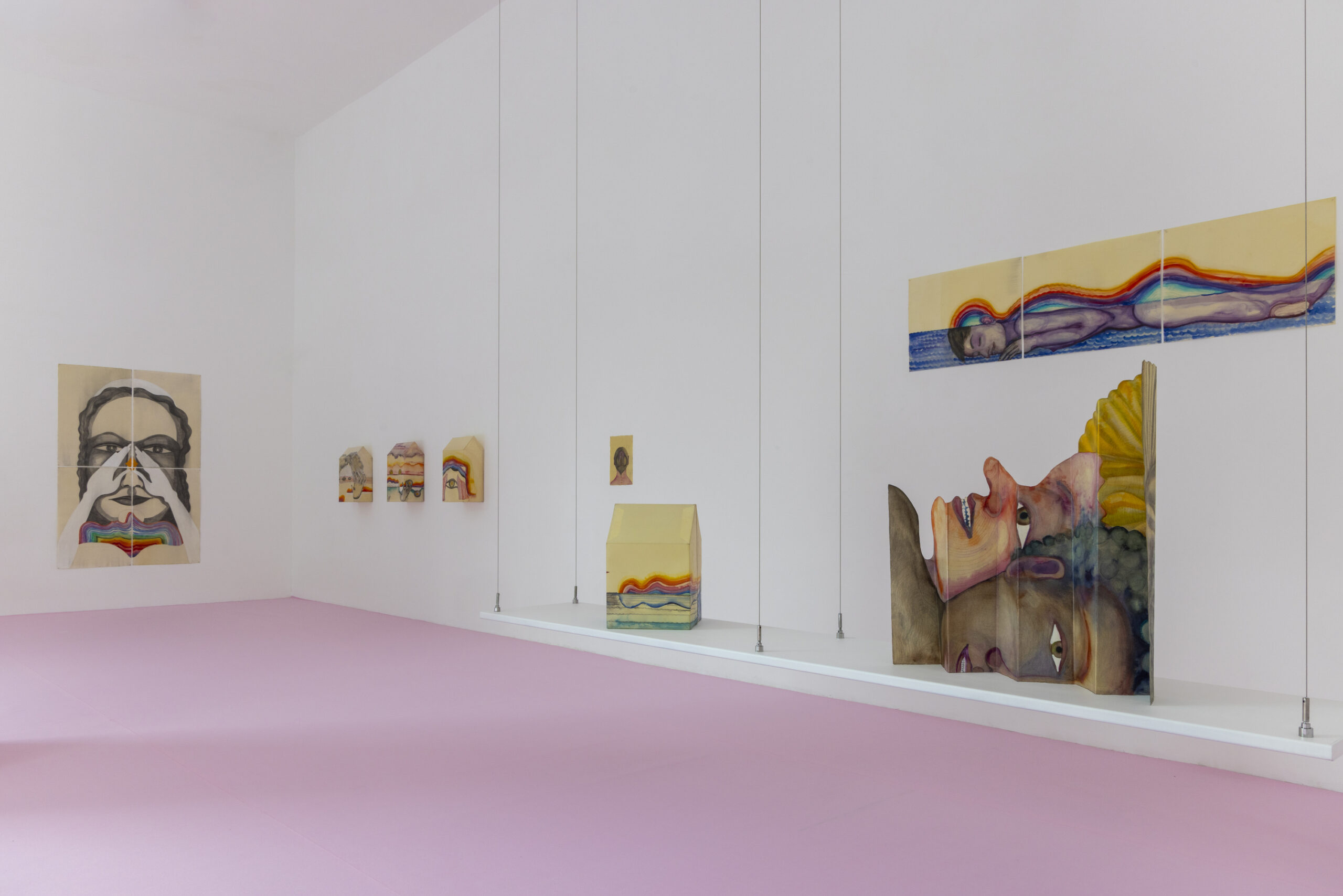
Born in Viña del Mar, Chile, in 1967 and based in Berlin for more than fifteen years, Vásquez de la Horra has developed a singular practice centred on drawing. In her work, the medium transcends its two-dimensional format to take on sculptural and installation-based dimensions. Since the late 1990s, she has finished her drawings by dipping them in wax, a process that gives them greater plasticity and material presence while intensifying line and colour and creating effects of depth and translucency.
Vásquez de la Horra has been the subject of major institutional exhibitions, including Soy Energía, her first institutional retrospective in Europe, which opened at Haus der Kunst in Munich in 2025, and The Awake Volcanoes, a career-spanning exhibition presented at the Denver Art Museum in 2024 and curated by Raphael Fonseca. She received the Käthe Kollwitz Prize from the Akademie der Künste in Berlin in 2023 and participated in the 59th Venice Biennale in 2022.
Her work draws on sources ranging from cinema and fairy tales to botanical and zoological compendiums. These references are interwoven with personal experiences and broader historical contexts, including the political repression she experienced during her youth under Augusto Pinochet’s dictatorship in Chile.
The traditions and mythologies of her Chilean background and Aymara ancestry play a central role in her work, alongside systems of knowledge and symbols associated with Afro-diasporic religions such as Santería, into which she was initiated in Cuba in 2003. Within this visual universe, religion, mythology, sexuality and uncanny elements coexist and collide, giving shape to narratives of transformation and symbolic experiences of the body.
“Curiously, my work is not about imagination, as many people think. It has to do with my experience of the world, my relationship with the gods and with things. It is like a diary. The works are the result of the contact I establish with the elements, with the trees, with the birds, with the water, with everything around me. When they cut down a tree on the street where I live, I suffer, because the trees are my friends, you know?”
Recurring throughout her drawings, the female figure appears in a state of constant mutation: at times as a generative and cosmic force, at others marked by vulnerability and violence. Human, animal and vegetal bodies merge in hybrid compositions in which dreamlike landscapes and organic forms suggest cycles of life, death and rebirth.
Symbols associated with Indigenous traditions and marginalised cultures emerge as emblems that challenge historical and cultural narratives, particularly within the context of Latin America. In her more recent work, Vásquez de la Horra has expanded drawing into space through folds and sculptural structures that emphasise its three-dimensional qualities.
Fernanda Morse on the work
“Sandra Vásquez de la Horra’s work operates through a rich convergence of knowledge systems, cosmovisions, rituals, and symbolisms capable of expanding our worldview and activating our sensitivity toward all living things around us. Going beyond schisms and dualities, the images and forms created by Sandra connect inside and outside, body and spirit, sacred and profane, human and animal. Her work blurs boundaries and founds a universe in which the distance between nature and civilization no longer exists, and these concepts may finally collapse.”
The exhibition at Gomide&Co offered an insight into the recent development of Vásquez de la Horra’s practice and highlighted the consistency of a body of work that sensitively and incisively investigates the relationships between body, spirituality, experience and memory.
Learn more at Gomide&Co.